What types of scaffolding are there? 6 systems are presented. The big overview & their areas of application.
Scaffolding types differ according to area of application, working height and load requirement.
The most important scaffolding types include facade scaffolds, modular scaffolds, spatial scaffolds,
roof safety scaffolds, mobile scaffolds and special scaffolds.
The choice of the right scaffold depends on the respective construction task
and the applicable safety requirements.
Scaffolding types are functional structural elements in construction that ensure access and reduce the risk of falls.
The guide names the most common systems – facade scaffolding, modular scaffolding, spatial scaffolding, roof safety scaffolding, mobile scaffolding and special scaffolding – and shows which type is practical for which application and at what height.
For many jobs on buildings, a permanent or temporary scaffolding solution is required; in practice, fall protection, often in the form of a scaffold, is provided from certain fall heights. Later in the article, you will find information on load classes, platform widths, height, material selection and relevant standards (e.g. DIN EN 12811-1, TRBS 2121-1).
Key findings
- Overview of the common, different scaffolding types and their typical areas of application.
- Scaffolds provide access, work safety and material storage.
- Selection according to application, height, load and width class determines suitability.
- Standards such as DIN EN 12811-1 provide specifications for planning and execution.
- The basis for planning and execution includes the specifications of DIN EN 12811-1 and the Technical Rules for Operational Safety (TRBS 2121-1).BG-BAU
Why there are different types of scaffolding and when scaffolding is required.
The choice of scaffolding depends on the working height, building geometry and the material required. A frame scaffold is often sufficient for simple facade work; a roof safety scaffold makes sense for roof work; a mobile scaffold is ideal for changing interior work.
Typical construction work and safety benefits
For plastering, painting and assembly work as well as maintenance work, a scaffold creates safe access and ergonomic work surfaces. This reduces ascents and descents and improves process efficiency on the construction site.
Protective scaffolds also protect traffic areas and passers-by from falling parts; they thus reduce the risk of accidents and operational liability risks.
Obligation and practice from relevant fall heights
Whether scaffolding is required depends on the legal requirements and the company’s risk assessment; in practice, a scaffolding solution or equivalent fall protection is often provided for fall heights of approximately 2.00 m or more. Check the applicable regulations and manufacturer’s instructions in individual cases.
Basics for selection: application, height, load and width
The selection depends on three core questions: Where does the work take place, what height is required and what loads must be carried?
A pragmatic approach makes the choice easier: 1) determine application and use, 2) determine the necessary height, 3) check load and width requirements, 4) select system and material and 5) create assembly concept.
Load classes according to DIN EN 12811-1
The standard distinguishes load classes for different uses. For example, load class 3 covers light work such as painting; higher load classes must be selected for assembly or masonry work. Orient yourself to the required payload and document the selection in the plan.
Width classes W06–W12
The platform width influences material transport and two-way traffic. Narrower platforms (W06–W09, 0.60–0.90 m) are common for painting or roofing work; wider platforms (W09–W12, 0.90–1.20 m) make sense if material storage and encounters occur frequently.
Maximum working heights in practice
Mobile working scaffolds are typically used indoors up to approximately 12 m and outdoors up to approximately 8 m, depending on the system and manufacturer’s specifications. Stationary scaffolds are planned significantly higher on a project-related basis; static calculations are required for this.
- Systematics for practice: application → height → load → width → assembly/material.
- During assembly, access points, anchoring and field sizes must be planned in such a way that later use is safe and efficient.
Material and system: steel scaffold, aluminum and manufacturer systems
The choice of material and system influences assembly time, transport costs and the economic efficiency of a construction project.
Aluminum is significantly lighter and reduces physical strain during assembly and disassembly. This shortens assembly times, especially for mobile and facade scaffolds, and lowers transport costs.
Steel offers greater robustness and can be more economical for permanent applications or high load classes. The decision is based on project duration, load requirements and logistics.
System scaffolds and plug-in systems in the design
Plug-in systems and frame scaffolds simplify assembly and reduce the need for tools. Standardized components facilitate spare parts supply and expansions.
- Weight & transport: Aluminum reduces weight and handling.
- Assembly time: Plug-in systems speed up execution.
- Total costs: Steel can be cheaper for long-term use.
Manufacturer systems differ in availability, expandability and documentation. When choosing a system, pay attention to test certificates, interchangeability of parts and the manufacturer’s instructions for safe execution.
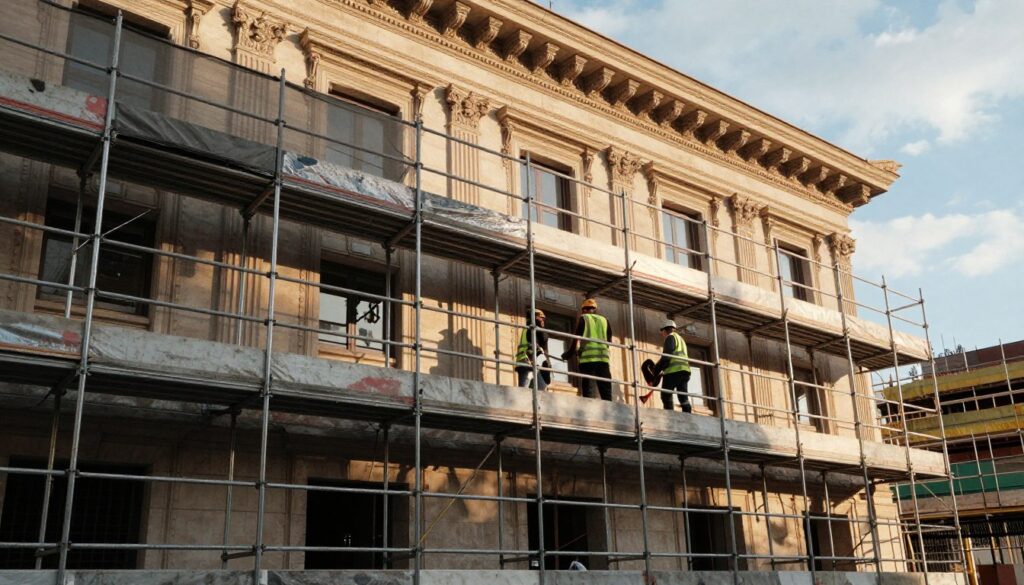
Facade scaffolding – a classic for facades and renovation
Length-oriented stationary scaffolds along the facade are the standard solution for work on the outer shell. They combine safe work areas with material storage and allow direct access to buildings.For detailed information on assembly and areas of application, we recommend our page on facade scaffolding. -> https://www.geruestbau-mueller.de/fassadengeruest/
Working scaffold vs. protective scaffold: benefits and load-bearing capacity
A working scaffold primarily serves as safe access and a work surface for craftsmen; it is designed according to relevant standards (e.g. DIN EN 12811‑1) with regard to load-bearing capacity and platform width. Typical load assumptions depend on the planned use of materials and the use.
Protective scaffolds also have the task of protecting passers-by and traffic areas from falling parts; this includes catch scaffolds or protective roofs with suitable cladding.
Modular scaffolding: maximum flexibility for complex construction projects
Modular scaffolds solve tasks where prefabricated frames reach their limits. They consist of standardized vertical and horizontal components with a node principle that allows a variety of connection options.
Assembly principle and nodes: Several bars can be attached to a node at different angles, which means that curves, offsets and complicated geometries can be reliably scaffolded. Such systems are a practical solution for complex requirements.
Typical applications
Modular scaffolds are used in industrial and commercial construction, bridge work and special geometries. Examples include the scaffolding of pipelines, machine halls or bridge undersides, where flexible connection angles and high adaptability are required.
Combinations and extensions
Stair towers, consoles and cantilevers complement modular scaffolds and facilitate material supply and ergonomic work routes in the project. Modular components also allow selective reinforcements where higher loads occur.
Decision-making aid: Choose a modular scaffold if the geometry or requirements are such that the higher planning and assembly costs are offset by savings on special parts and lower additional costs on site. When choosing a system, consider the availability of spare parts, manufacturer documentation and compatibility with existing material.
Spatial scaffolding: surface-oriented scaffolding for interiors and halls
Spatial scaffolds are used when large ceiling areas need to be made safely and efficiently accessible. They create a work surface directly under the ceiling and enable work over an area instead of along an edge.
Definition & logic: Unlike length-oriented facade scaffolds, spatial scaffolds are surface-oriented; they cover halls or naves and are planned in such a way that access points, passages and work zones are retained.
Typical projects:
- Churches and historical vaults
- Gymnasiums and sports facilities
- Industrial halls for ceiling, lighting or assembly technology
Ergonomics and height
A distance of approximately 2.00 m below the ceiling is often practical so that work can be carried out in an ergonomic posture; the distance may vary depending on the project. Use the height so that material supply and work space fit together optimally.
Roof safety scaffolding and roof edge protection: protection on the roof when working at height
Work on the roof edge requires specific protective measures. The decision between a complete roof safety scaffold and temporary edge protection depends on the duration of use, material handling and the local geometry. You can find more information on safe scaffolding for roof work in our roof scaffolding section. – > https://www.geruestbau-mueller.de/dachgeruestbau/
Roof safety scaffold / roofer’s scaffold: side protection, nets and safe working areas
Roof safety scaffolds offer continuous side protection on the roof edge and allow the attachment of safety nets and protected material zones. They create clearly defined work areas for roofers and enable safe material circulation.
Alternative solutions: temporary roof edge protection for flat roofs
For short-term interventions or on flat roofs, temporary solutions such as purlin or parapet clamps, folding railings or ballasted railing systems are practical alternatives. These systems are quicker to install, but do not always achieve the protective effect of permanently installed systems.
- Complete roof safety scaffold: recommended for longer work, high material transport or frequent use.
- Temporary edge protection: suitable for short operations with low material requirements.
Safety checkpoints: Assembly according to manufacturer’s instructions, keeping traffic areas clear, coordination with other trades and regular visual inspections during work.
“The right solution on the roof depends on use, duration and weather conditions.”
Mobile scaffold and rolling scaffold: mobile work platforms for quick operations
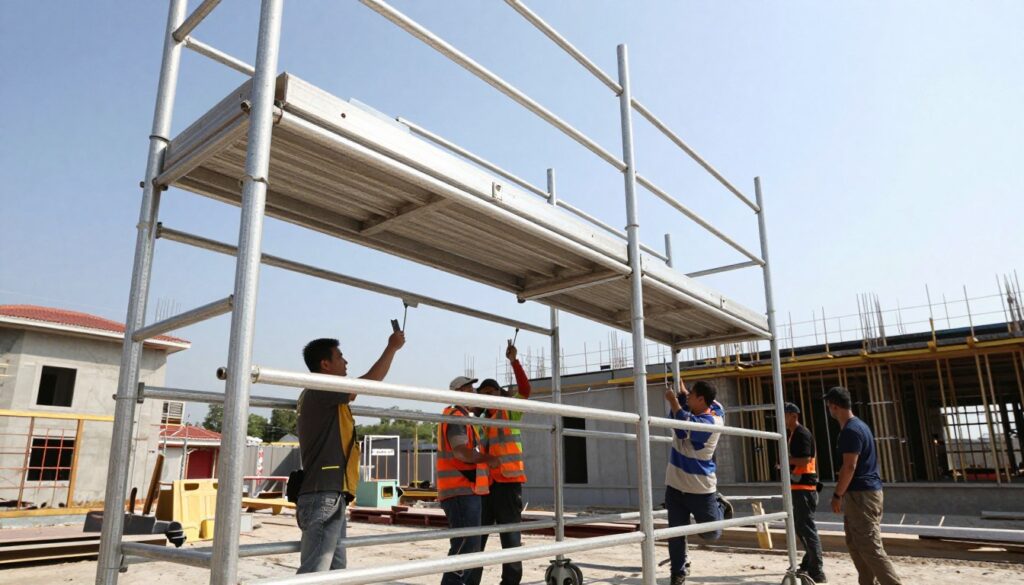
Mobile and rolling scaffolds are mobile work platforms for frequently changing workplaces. They reduce assembly effort and are economical when short, recurring operations are required.
Definition & benefits: A mobile scaffold or rolling scaffold is mobile and facilitates use for indoor and outdoor work; mobility saves time compared to stationary scaffolds.
Advantages in practice
- Quick assembly and disassembly — suitable for short operations and recurring tasks.
- High flexibility within a project due to rapid changes of position.
- Aluminum construction reduces weight and simplifies transport and handling.
Typical areas of application and limits
Mobile scaffolds are often used for interior finishing, ceiling renovations, technical installations and smaller facade work. Practical limits depend on the system: typically up to approximately 12 m indoors, approximately 8 m outdoors; wind and the ground limit use.
Safe working
- Only roll on level, load-bearing ground and use parking brakes.
- Never drive with people on the platform in a rolled state.
- Observe wind risks outdoors; brace or ballast if necessary.
“Mobile scaffolds are suitable where time, mobility and short operating times count.”
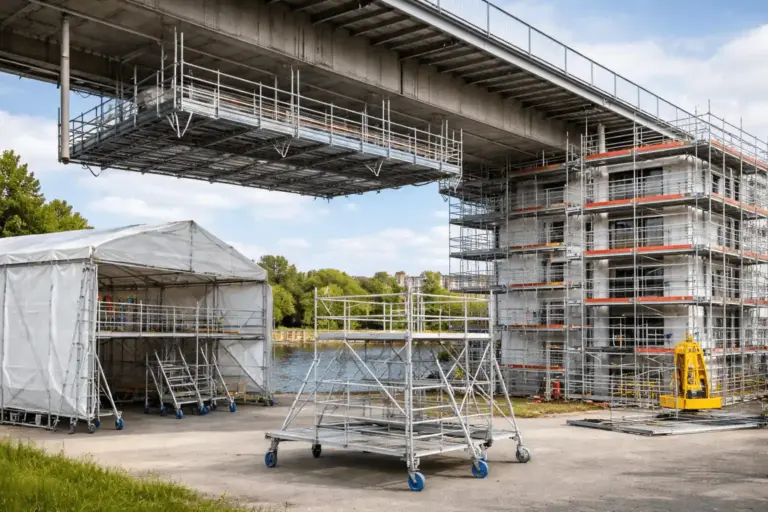
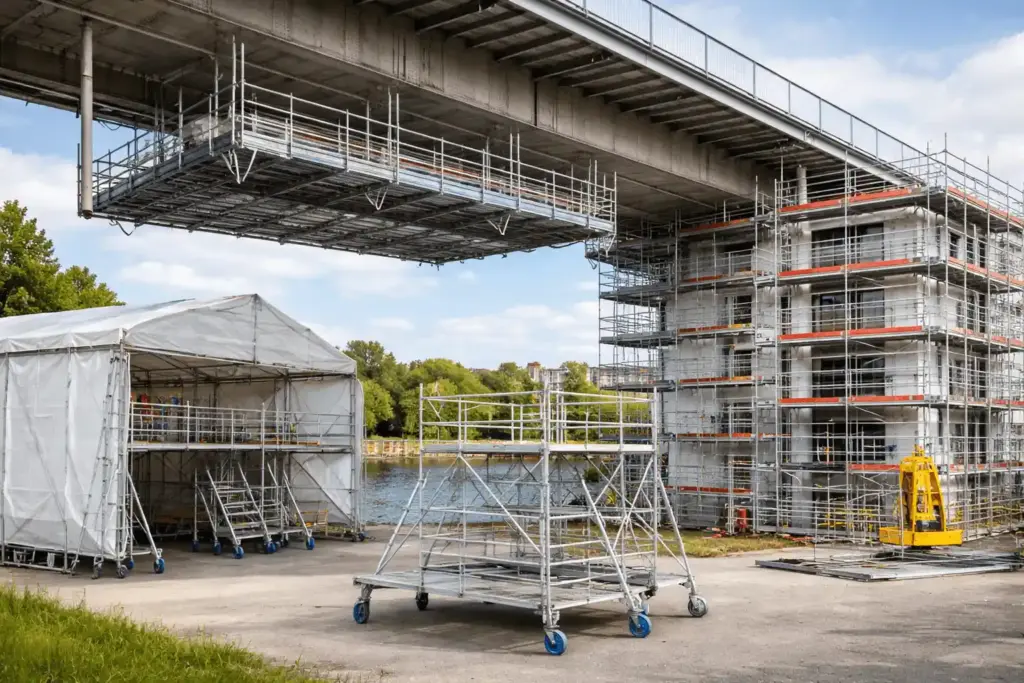
Special scaffolds: suspended scaffolds, weather protection, enclosures and event structures
For special requirements, special scaffolds offer targeted solutions: suspended scaffolds, enclosures, weather protection roofs or modular event structures. These systems require project-related planning and tested evidence. More on the topic: https://www.geruestbau-mueller.de/sondergerueste/
Suspended scaffolds & bridge scaffolding
If there is no load-bearing surface below, suspended scaffolds are used, for example over water or on bridges. They avoid supports on the ground and allow access to difficult-to-reach places, but require a reliable static calculation and tested suspension points.
Static calculation and suspension points
Static verifications and documentation are mandatory. Suspension points are guided over existing steel beams, built-in concrete anchors or specially planned foundations; lifting equipment and support cables must be tested and logged.
Enclosures and scaffold cladding
Enclosures reduce dust, noise and weather influences. Common claddings are flame-retardant tarpaulins, dust protection nets or special nets for blasting work; the selection depends on emission requirements and occupational safety.
Weather protection roofs and mobile versions
Weather protection roofs enable weather-independent work, for example in The winter or during long-running construction phases. Mobile roof structures can be more economical for very large areas; spans and design depend on the system and require a static test.
Grandstands and stages
Modular grandstands and stages are possible as special constructions. They must be planned and tested with regard to load-bearing capacity and the requirements of the assembly hall regulations.
“Special scaffolds require tested statics, documented lifting equipment and project-related execution planning.”
Conclusion
In short and practice-oriented terms: The right scaffolding solution results from the application, required height, load and width class as well as the material and system decision.
- Facade scaffolding: Standard solution for work on facades and renovations.
- Modular scaffolding: Choice for complex geometries or industrial applications.
- Spatial scaffolding: Surface access in interiors and halls.
- Roof safety scaffold: Protection on the roof edge; temporary edge protection only for short operations.
- Mobile/rolling scaffold: Mobile solution for short, recurring work.
- Special scaffolds: Suspended scaffolds, enclosures or weather protection for special cases.
Material note: Aluminum reduces weight and assembly time; steel remains economical under permanent load. Pay attention to tested execution and manufacturer documentation.
Further information on our scaffolding services can be found here: https://www.geruestbau-mueller.de/leistung/
FAQ
What types of scaffolding are there and what are they used for?
There are facade scaffolds, modular and frame scaffolds, mobile and rolling scaffolds, roof safety and suspended scaffolds as well as special scaffolds. Depending on the construction task, they are used for facade, interior, roof, industrial or special work.
When is scaffolding mandatory?
Whether scaffolding is required depends on the fall height, the activity and the risk assessment. In practice, scaffolding or equivalent fall protection is often provided from a fall height of approximately 2.00 m.
What does DIN EN 12811-1 regulate?
DIN EN 12811-1 specifies requirements for working and protective scaffolds, including load classes, platform widths, railings and load-bearing capacity.
Steel or aluminum scaffold – what is better?
Aluminum scaffolds are lighter and quicker to assemble, steel scaffolds are more robust and often more economical for high loads or long operating times. The choice depends on the project.
What are the advantages of system or modular scaffolds?
System and modular scaffolding offer high flexibility, rapid assembly, and numerous connection options. They are particularly well-suited for complex geometries or industrial applications.
Which interior projects are suitable for a spatial scaffold?
Frame scaffolding is suitable for churches, halls, and industrial facilities when large-area ceiling or lighting access is required.